


Northeast-India – Afterthoughts
5. + 14. Dezember 2025

Before I get to my reflections afterward, I first want to tell the end of the journey. Because it did not go as planned. We had a flight with IndiGo from Dimapur to Delhi and wanted to spend the time until the afternoon visiting the Hornbill Festival again and a few villages. However, IndiGo was facing massive disruptions: it had been determined that staff were working too much and getting too little rest. To put a stop to this, new working conditions were enforced—which led to a huge wave of flight cancellations. On day one, 300 flights were canceled; on day two, 500; and for December 5th, 1,000 cancellations were expected. Indian air traffic descended into complete chaos. People tried to secure alternative flight tickets at outrageously inflated prices; others were simply frustrated; routes were completely booked out; and there was baggage chaos at the airports. We were scheduled to fly on December 6th. During the night of the 5th, all IndiGo flights to and from Dimapur were canceled. To get the group home in time, an alternative plan had to be found.
Our colleague in Delhi rushed to his office and did his best. We decided that instead of continuing with the planned program, we would drive straight to Guwahati. Dimapur is a small airport with only a few daily flights, whereas Guwahati offers far, far more options. If there was any chance at all, it would be there. So we set off.
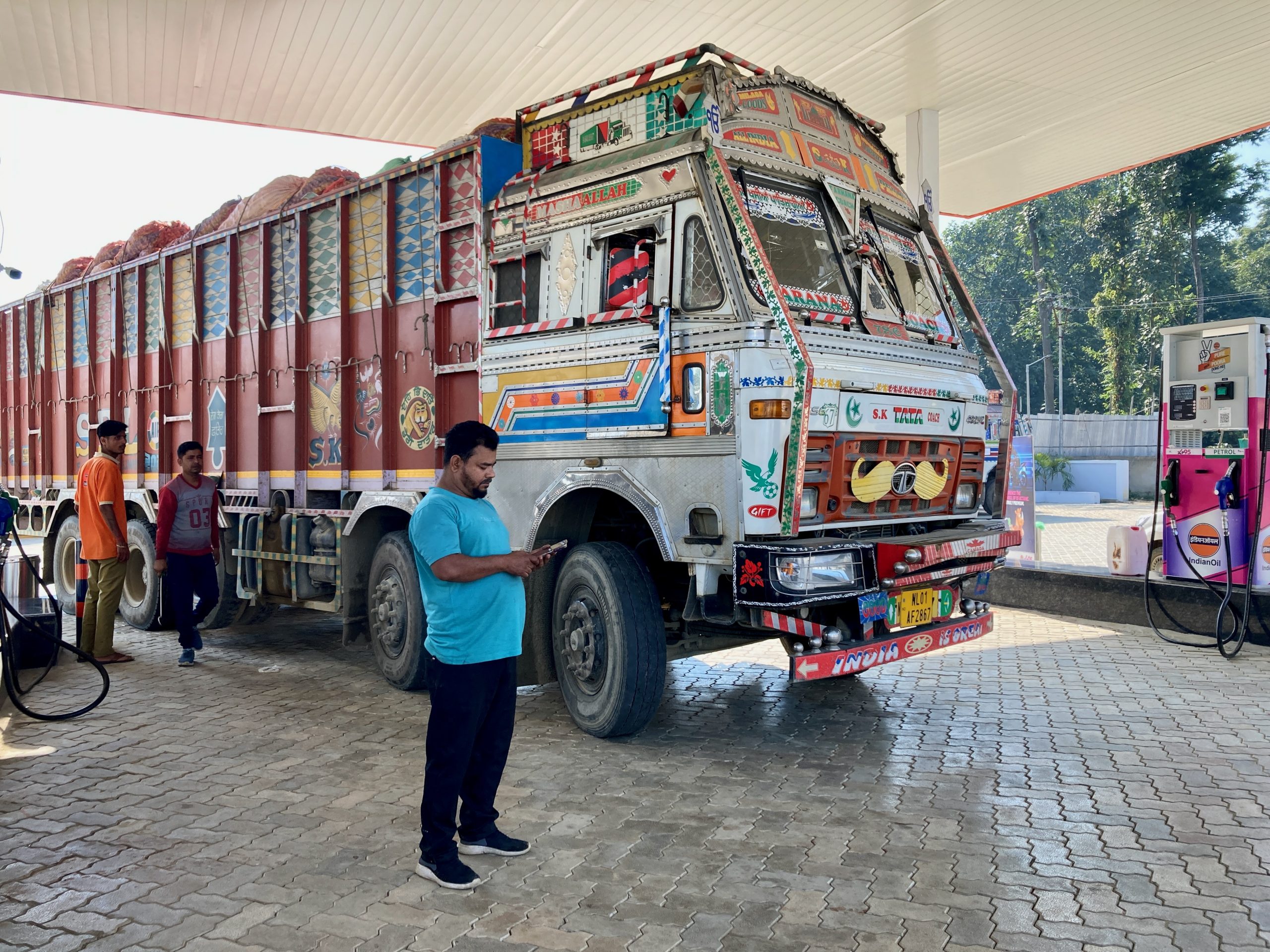 petrol-pump-stopp
While we were driving, I kept receiving updates. It must have been horrific. Every time our colleague found a better flight and tried to enter our names, it was already gone—fully booked. In the end, we ended up with an unusual connection: we were to fly early in the morning from Guwahati to Jaipur, and from there continue by minibus to Delhi airport. And that’s exactly how it worked out.
In der Nacht oder am frühen Morgen kam dann die Meldung, dass die neuen Regelungen für IndiGo erstmal wieder aufgehoben wären. Es war einfach nicht zu bewältigen, man konnte sich ja nicht mehr Personal “aus den Rippen schneiden” oder die Flugpläne reduzieren und anpassen – es war ja alles bereits bebucht. IndiGo selber rechnete frühestens ab Februar mit einem regulierterem Flugbetrieb. Monatelanges Chaos im Flugbetrieb, das schien schlimmer als auf die sofortige Umsetzung der neuen Regeln zu beharren. Für den 6. Dezember sollten also alle Flüge wieder normal operieren. Allerdings waren die Maschinen teilweise nicht da, wo sie hingehörten und es würde definitiv wieder ein ruckeliger Tag werden. Es kann gut sein, dass unser Ursprungsflug ab Dimapur doch ging – aber das Risiko war viel zu hoch gewesen.
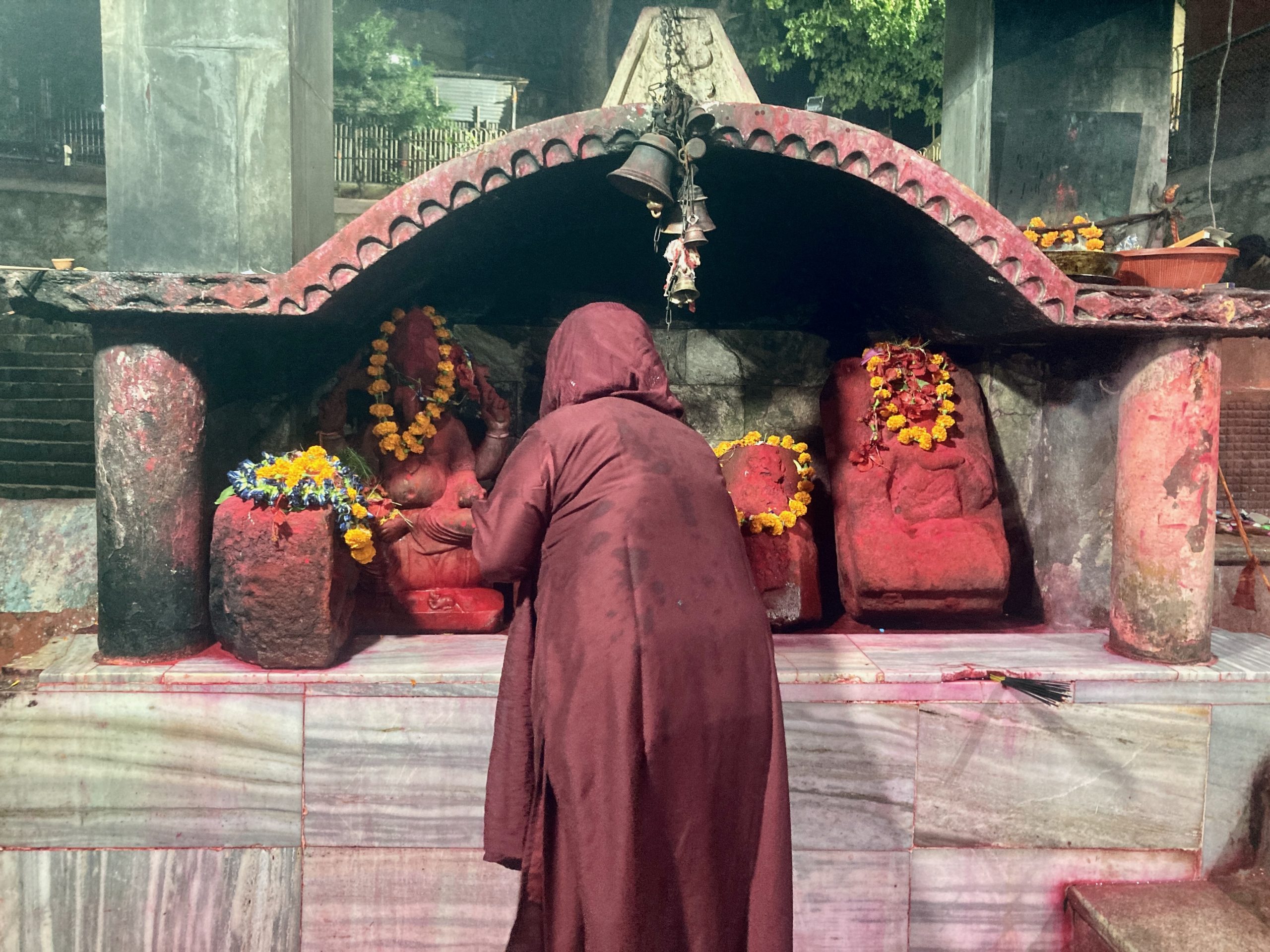
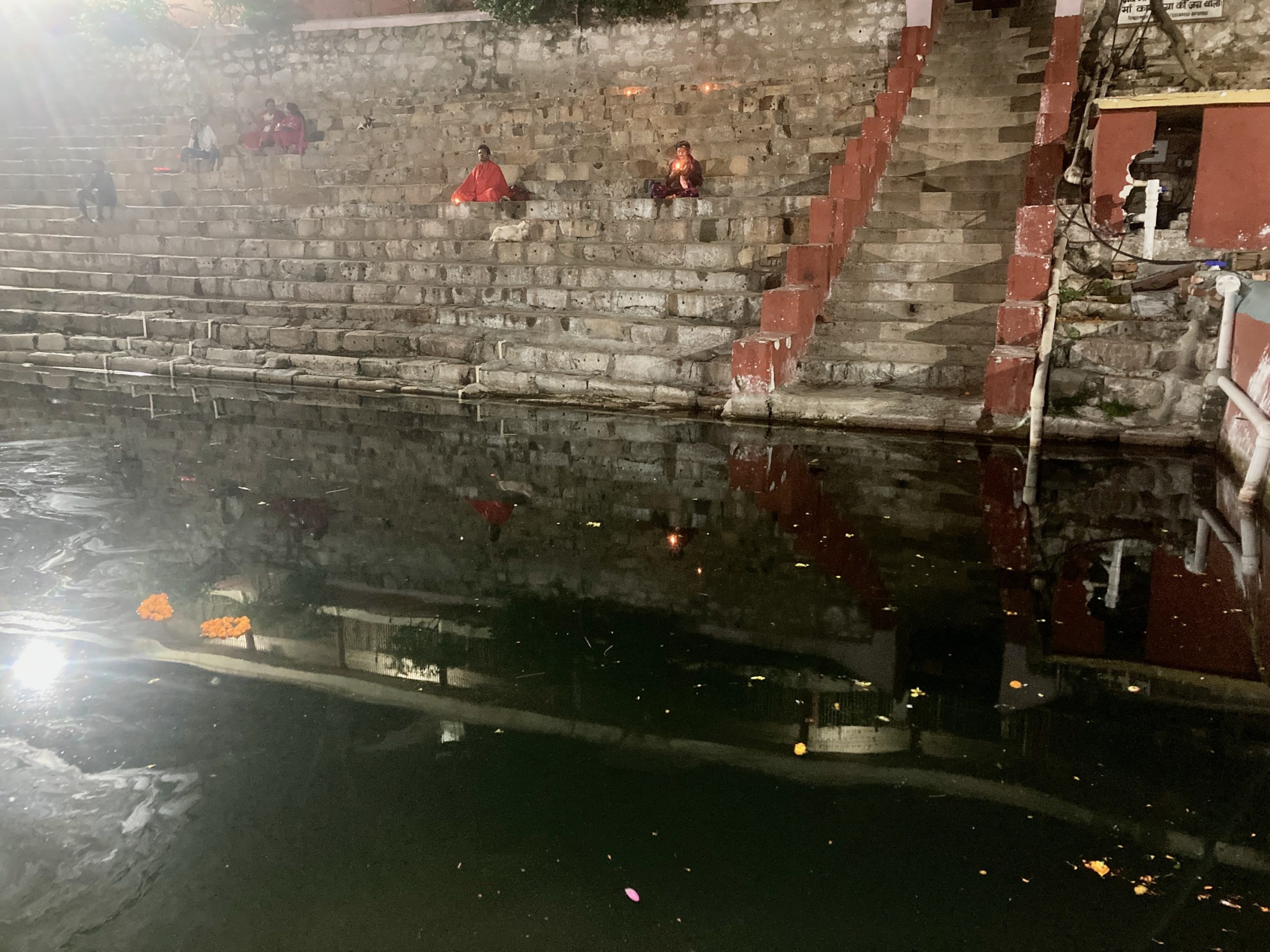
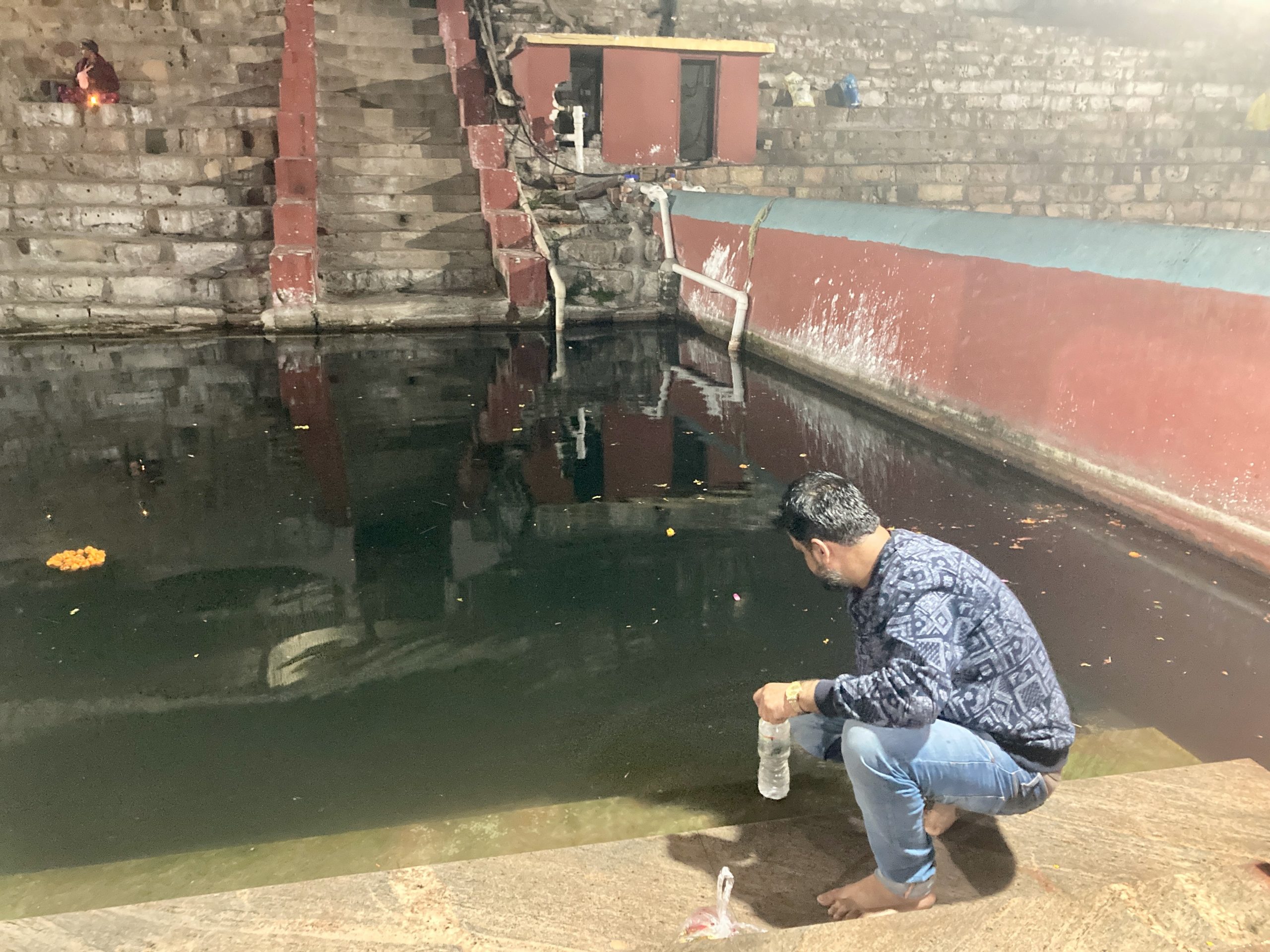
So hatten wir eine lange Fahrt nach Guwahati, aber dort noch die Gelegenheit, den Maa Kamakhya Tempel zu besuchen. Der war dann sogar noch ein kleines Highlight für die Gruppe. Ich machte nur ein paar zusätzliche Bilder zu meinem Erstbesuch – diese nutze ich als visuelle Unterbrechungen meiner Nachgedanken. Ich war jedenfalls froh, dass ich die Gruppe pünktlich zu ihrem Heimflug in Delhi am Flughafen verabschieden konnte.
 another Christmas tree
Afterthoughts
These five weeks in Northeast India were very full, and it was clear to me that it would take time for everything to sink in. I’m not through with it yet. In the blog post before the trip I wrote: “My head is full of information and buzzing!”—and it still is today. Usually, after traveling to a new region, I ask myself whether I would want to go there again. For the Northeast, my answer is a clear “yes and no”.
What I found attractive:
- The people are consistently friendly and make traveling and being there easy and pleasant
- I find the individual histories of the states and the current socio-political developments extremely fascinating
- there are few other western travellers
- the mountain landscape is beautiful
- it is very diversified
- Arunachal Pradesh remains my favorite — though I would rather want to go further west (to Tawang Monastery) and north (to the higher mountains)
- I saw only 2 snakes
 1
1
What didn’t excite me as much
- the overwhelming presence of Christianity, including missionary activities
- the travel restrictions involving permits
- the personal connections that make a place feel more accessible were rare (really only Asi in Kigwema and Monjit plus Raju on Majuli)
- I can’t quite connect with the exoticism of Indigenous people / I have some difficulty engaging with it.
- the fast travel with the group
 2
2
About the single states:
Arunachal Pradesh
I found it appealing because of its rural character, the resistance to missionary activity, and the mountain landscape. The areas to the north and west still spark my curiosity. I can, in good conscience, include it in my travel offerings — though the infrastructure is still quite basic and can be uncomfortable at times. I think I could easily fill three weeks there for myself — and there would even be trekking opportunities. Unfortunately, as in Sikkim, access is restricted in terms of where I’m allowed to go.
Assam
I find Majuli a charming place, and what I visited in Guwahati, Kaziranga, and Sibsagar quite interesting. There are also good opportunities for wildlife viewing (even if that doesn’t particularly excite me personally). Overall, though, it seems to me that within a large area there are only scattered “islands” of attraction, rather than the state being consistently compelling or having a strong, cohesive character of its own (like Ladakh or Rajasthan, for example). It can certainly be traveled well — but whether there are enough points of interest to fill, say, three weeks is something I would doubt.
Nagaland
I find it very polarizing. This dominant Christianity thing is highly off-putting for me personally and creates a sense of discomfort and inner resistance. At the same time, it is of course extremely fascinating to see which path this state is taking. I can still readily recommend it to travelers — precisely because of these intriguing aspects, and the landscape also has a lot to offer. The heavy focus on meat (it’s the Indian state with the highest meat consumption) is a bit off-putting, but there are still enough alternatives to be found. It remains to be seen how the permit situation will develop.
Meghalaya
ChatGPT said:
I didn’t go there at all, even though it had attracted me so much. In the meantime, I’ve had travel clients there who described it as the low point of their trip. I had imagined it more as a highlight. That makes me very curious now, and I would really like to see it for myself.
I think you can see that a return is not out of the question, but the enthusiasm isn’t quite there, so I’m not rushing to make new travel plans.
 3
3
Diamir Grouptour
I don’t really want to write much about this here. For me, it was a very difficult and challenging trip due to various factors. And the criticism of me as a tour leader is present and also understandable. In hindsight, I could have done some things differently—but given the circumstances, it wasn’t possible at the time. One takeaway: use ChatGPT more for trip preparation. That probably sounds strange, but in the absence of human help—which I had wished for and expected—I only realized after the trip how helpful AI could have been in sorting and organizing information. What I really liked: the group was a bunch of very different, strong personalities, but they worked together quite well. There were no major animosities among them, which was not only pleasant for me but also wonderful to witness. Otherwise, I found this trip too full (despite the downtime, especially after dark), too fast-paced, and too focused on Indigenous communities. That can really only result in superficial impressions and a jumble of information.
 4
4
Food for thoughts
Northeast India is excellent food for thought, mental stimulation, and reflection. So far, I’ve been missing a good counterpart for this kind of engagement — at the moment, ChatGPT is my best conversation partner. One example: I asked ChatGPT for suggestions on concrete trip preparation. It pointed me to a website that offered various behavioral tips. I stumbled over one of them and asked again. I found the response convincing and well explained. Here is part of that “conversation.” (unfortunately just in German):
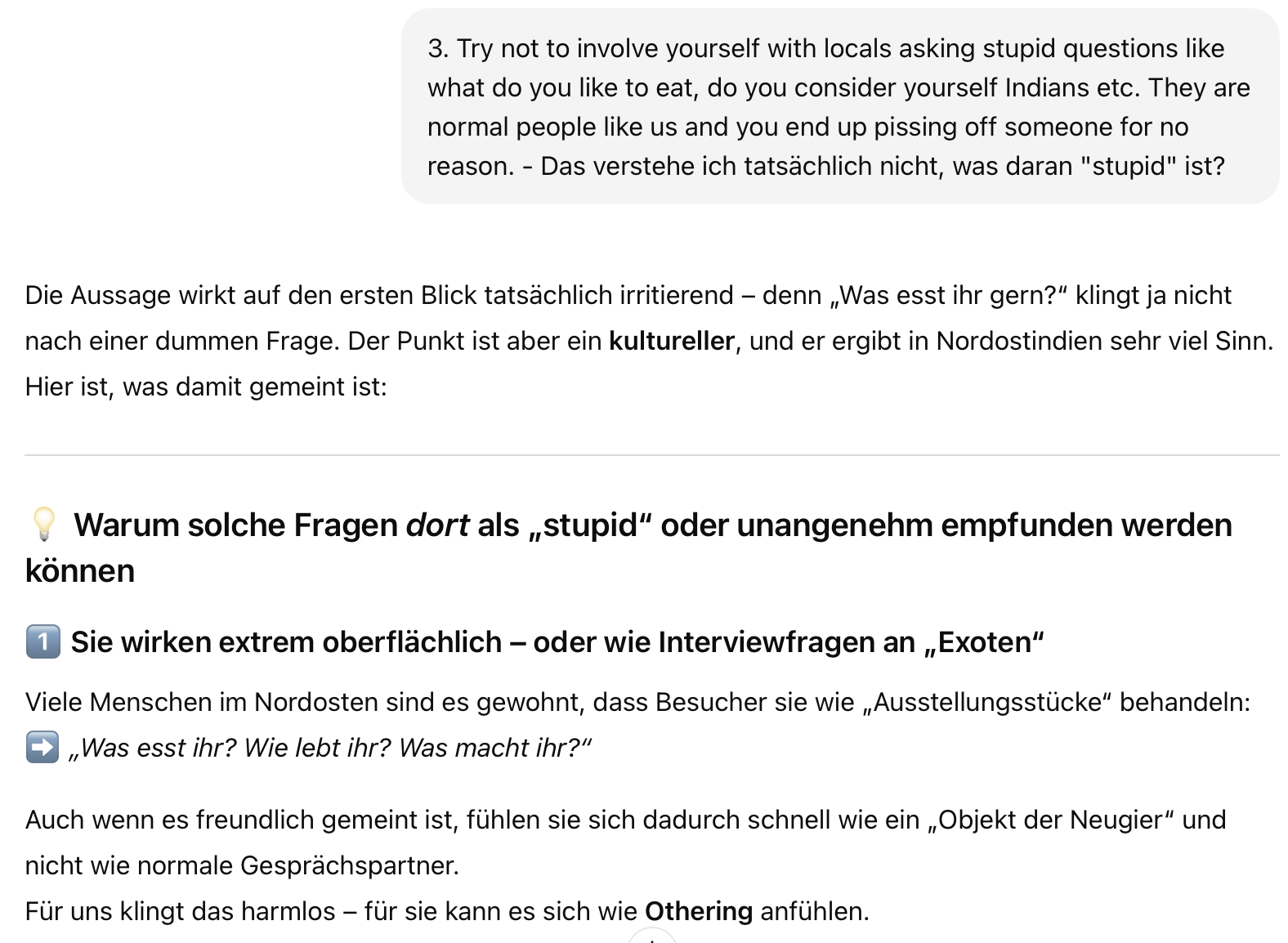 Screenshot
It reminded me once again how important presence and interaction are. Many years ago, I once went with an Indian acquaintance into a slum to learn more about the lives of the women there. And I immediately blurted out a question. My acquaintance called out, “Hey, stop, Nana — before you start asking questions here, you first have to tell them something about yourself. They want to know who they’re dealing with.” I did as instructed, and everything went well. Sometimes I forget that, and then it’s not great. But ChatGPT reminded me of that again. That said, I do believe I’m not that bad at communication — and in the end, the best thing is always when you find something to laugh about together.
 5
5
Graham Franklin
I just remembered another story I hadn’t mentioned: Parts of Nagaland think that all the fuss about the PAP and especially the delay in granting clearance for Hornbill had something to do with Reverend Franklin Graham. The U.S. evangelist Reverend Franklin Graham was scheduled to travel to Kohima (Nagaland, India) on November 30, 2025, for a large faith and revival event. He was supposed to attend a service with thousands of Christians and afterwards appear at the Hornbill Festival as a guest of honor. However, the Indian government did not issue his visa in time, or ultimately did not approve it, so he could not enter and his visit had to be canceled. Nagaland was upset and angry about this. For me, this makes him even more unsympathetic. Franklin Graham is known as an aggressive missionary, anti-LGBTQI (and a supporter of “conversion therapy”), and an Islamophobe. How can anyone enthusiastically follow such a man?
So, that’s it for the reflections for now. Perhaps I could call my time in Northeast India “scratching the surface.” I’ll probably continue to process a lot in the coming weeks, but it’s also time to focus more on the here and now. After all—the next tour I’m leading is already knocking at the door.