


Aryan Valley – Alexander, Aryans and Pregnancy Tourism
11. – 13. June 2026
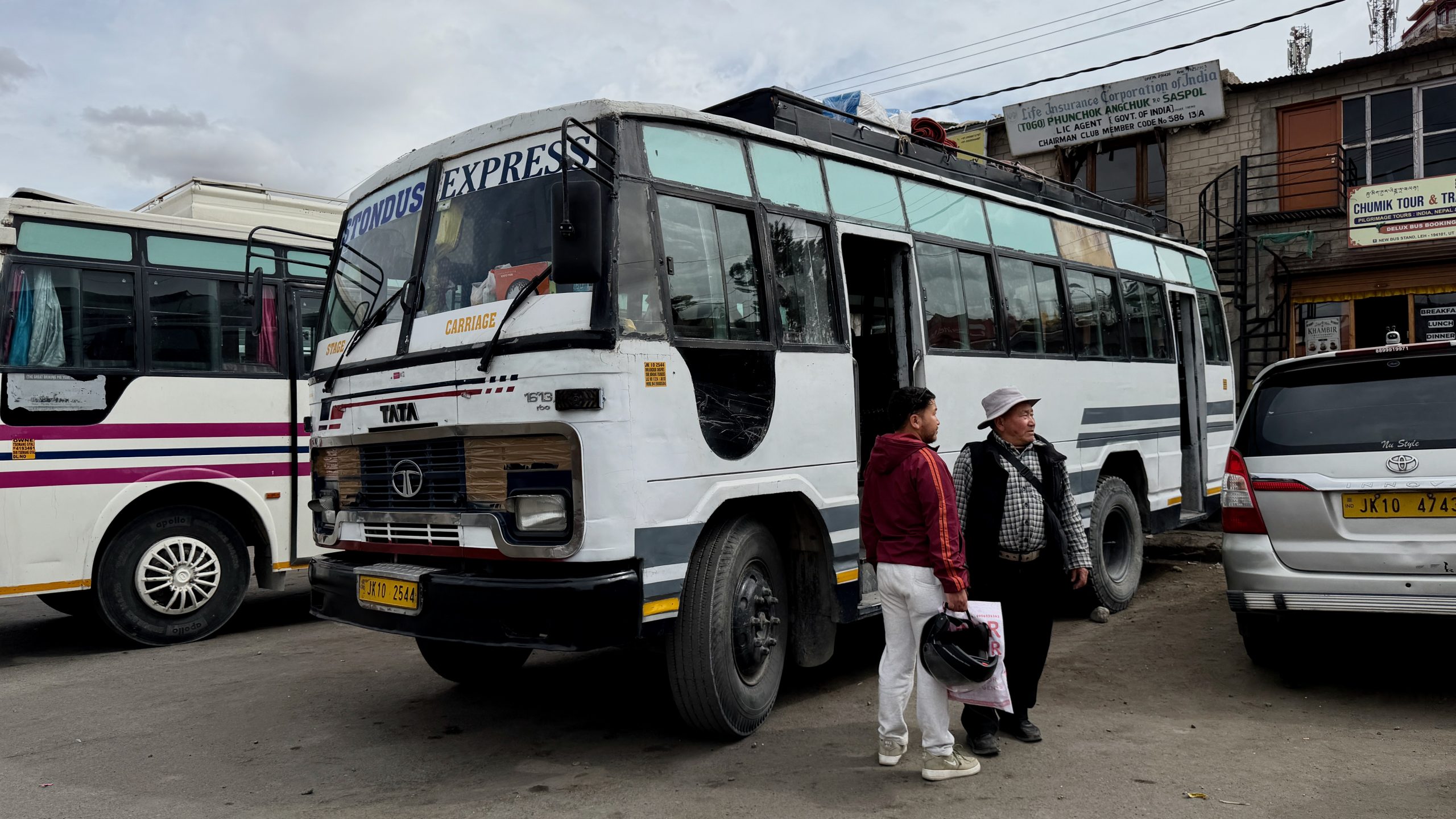
There is a region in Ladakh that continues to follow the Indus River after Khaltse. It used to be called the Dah-Hanu region and, with a permit, has been open to foreign travelers up to the village of Dah since 1994. Not many people came. So, they stepped things up and in 2010 opened the entire loop road all the way to Kargil (it runs quite close to the Pakistani border there) and renamed the area the Aryan Valley.
The Brokpa people live there—or strictly speaking, it’s about 1,500 people across five villages: Dah, Hanu, Beama, Garkone, and Darchiks. It seems to me you could do endless research on this and lose yourself in definitions. Visually, it’s about people who wear striking floral headdresses, even in their everyday lives, whose facial features look different from those of the Ladakhis, and who also speak a different language. Then there are the categories of history, religion, and so on—and I must admit that’s usually where I easily start to lose interest.
In any case, there are origin stories. One is that they are supposedly descended from Alexander the Great’s army, whose soldiers allegedly enjoyed themselves or even settled down here. But that story can’t be entirely true, as it has been proven that they never actually passed through here. Plus, even back then, the sheer distance would have made it highly unlikely because of the mountains—it certainly wasn’t a day trip from where the army was on campaign.
Now on to the Aryans. Let me try to summarize it. At the end of the 18th century, linguists discovered connections between certain languages, which were henceforth referred to as the Indo-European language family. And in the oldest Indian scriptures (the Vedas) and Persian texts, the immigrants there referred to themselves as Árya (Sanskrit) or Ariya (Old Persian). This simply meant “the noble” or “the honorable.” It was a purely linguistic and cultural term for the people who spoke these languages. Then, in the 19th century, a “language family” was turned into a “racial identity” (all defined from Europe, of course). The original “Aryans” were supposedly a physical human race—tall, fair-skinned, blond, blue-eyed, and intellectually superior to all other races. They were said to have once conquered Europe and parts of Asia, but subsequently weakened themselves by mixing with the local populations. When British colonial officials, surveyors, and anthropologists mapped the Indian borderlands with Tibet in the late 19th century, they came across the Brokpa. For the researchers, this was a visual and linguistic feast: the locally spoken Brokskat language was closer to Sanskrit than the neighboring Ladakhi/Bodhic, they were indeed fair-skinned, etc.—and somehow they came to the conclusion that these must be the true Aryans. In fact, virtually the last pure Aryans! In Western travel literature, the valley was henceforth romanticized as a kind of “living museum.” People fantasized that these individuals had been frozen in time millennia ago and had kept their blood “pure.” Which doesn’t really compute in my head, since it’s quite a long stretch from being just a bit fair-skinned, etc., to being blond, tall, and so on.
And to top off all these myths, I stumbled upon an entry beforehand on Google AI (sorry, I am too lazy to translate – it is about the phenomena of pregnancy tourism (european, especially german, women travel to the Aryan Valley to get pregnant by Brokpa-men due to pure “aryan genes”):
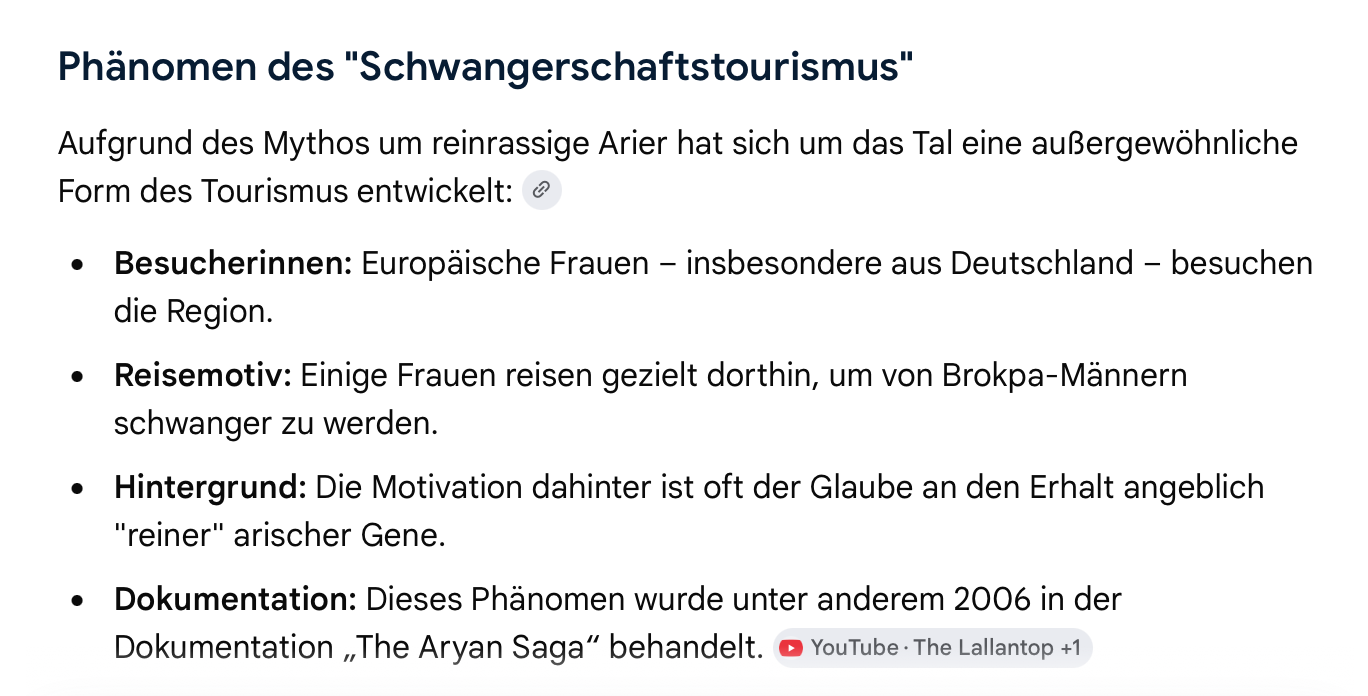
I only did a very brief search into that at first; it was just too absurd! I also found this piece by Manzoor Ahmad Khan from the year 2018:
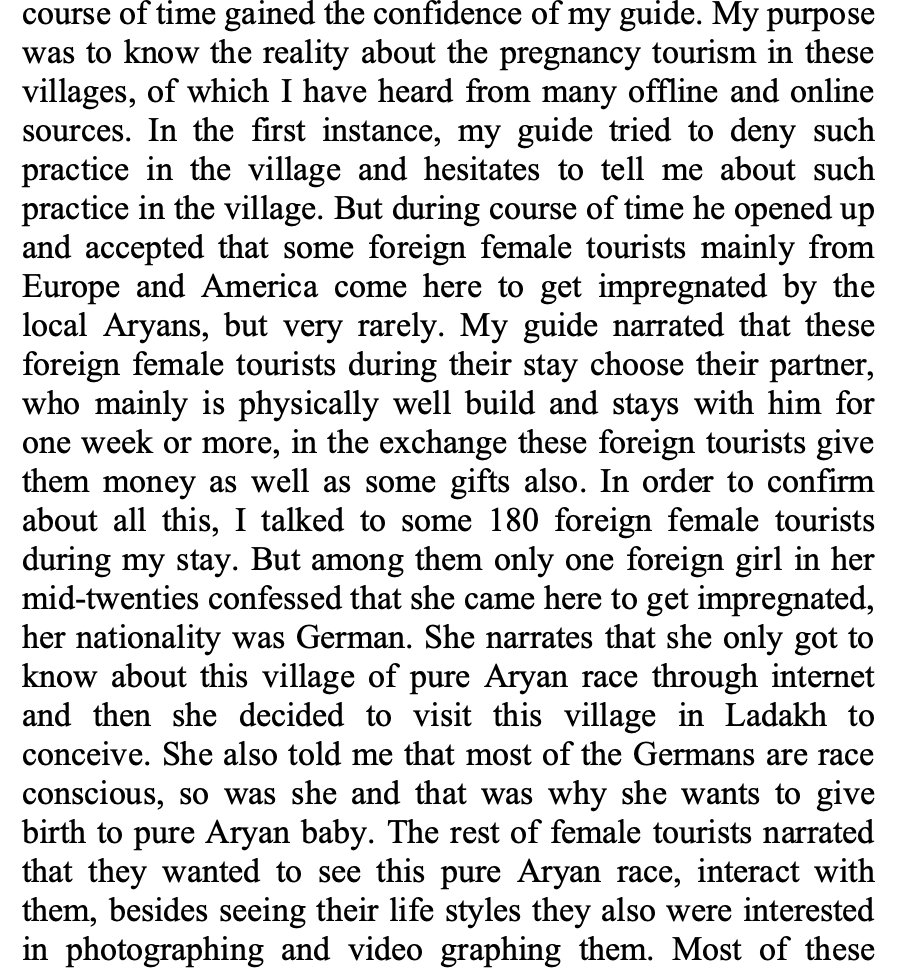
During the trip, I then asked my guide about it—it just gets more and more absurd….. He said he had heard that in the 1990s (the area has been open since 1994), about 20 German women arrived by plane, rented bicycles (back then, there weren’t even any bicycles in Ladakh…), cycled to the Brokpas, stayed there for a month, and all returned home pregnant.
Me: But why would they have done that?
Him: Well, during WWII, all the German men died, so there was a shortage of proper Aryans, and that’s why they looked for them elsewhere.
Me: But far too much time passed between the end of the war and the 1990s; they could have easily made up for that quickly with one Aryan man and ten Aryan women?
Him: Mmh, yeah, I guess that’s true.
Me: And what did the wives of the Brokpa men have to say about it?
Him: The German women gave them money!
Me: So getting foreign women pregnant in exchange for money is accepted then.
Him: But it’s probably not really like that anymore nowadays!
I am a bit perplexed. And once I was back, I did do a bit more research after all. If you type “Pregnancy Tourism Aryan” into YouTube, it spits out tons of videos by Indian men (hardly any by Indian women) dealing with “pregnancy tourism.”
Furthermore, Gemini says this:
“The specific origin of the pregnancy rumor dates back to a travelogue from the 1980s. In a 1980 book, the Indian alpinist and author H. P. S. Ahluwalia reported that he had met three German tourists with far-right or neo-Nazi backgrounds at a Brokpa cultural festival. They allegedly expressed to him that they had traveled to the region in the hope of getting pregnant by Brokpa men to have a ‘pure-blooded Aryan’ baby. Although this was most likely an extreme, isolated incident, the tabloid press eagerly picked up the story. In the following decades, the story was amplified worldwide by documentaries (such as The Aryan Saga in 2006) and sensationalist media reports, portraying it as if it were a thriving, organized business.”
WWhat a valley! What stories! I actually usually like stories, but this is a bit too much for my taste. And it is being touristically “exploited” as well. With the renaming to Aryan Valley (it used to be called simply the Dha-Hanu area), the emphasis on the “last pure Aryans,” the highlighting of visuals in the tourism marketing strategy, and the failure to clearly contradict the pregnancy tourism myth—all of this promotes a “fake cultural tourism.” Even so, I wanted to give it another chance.
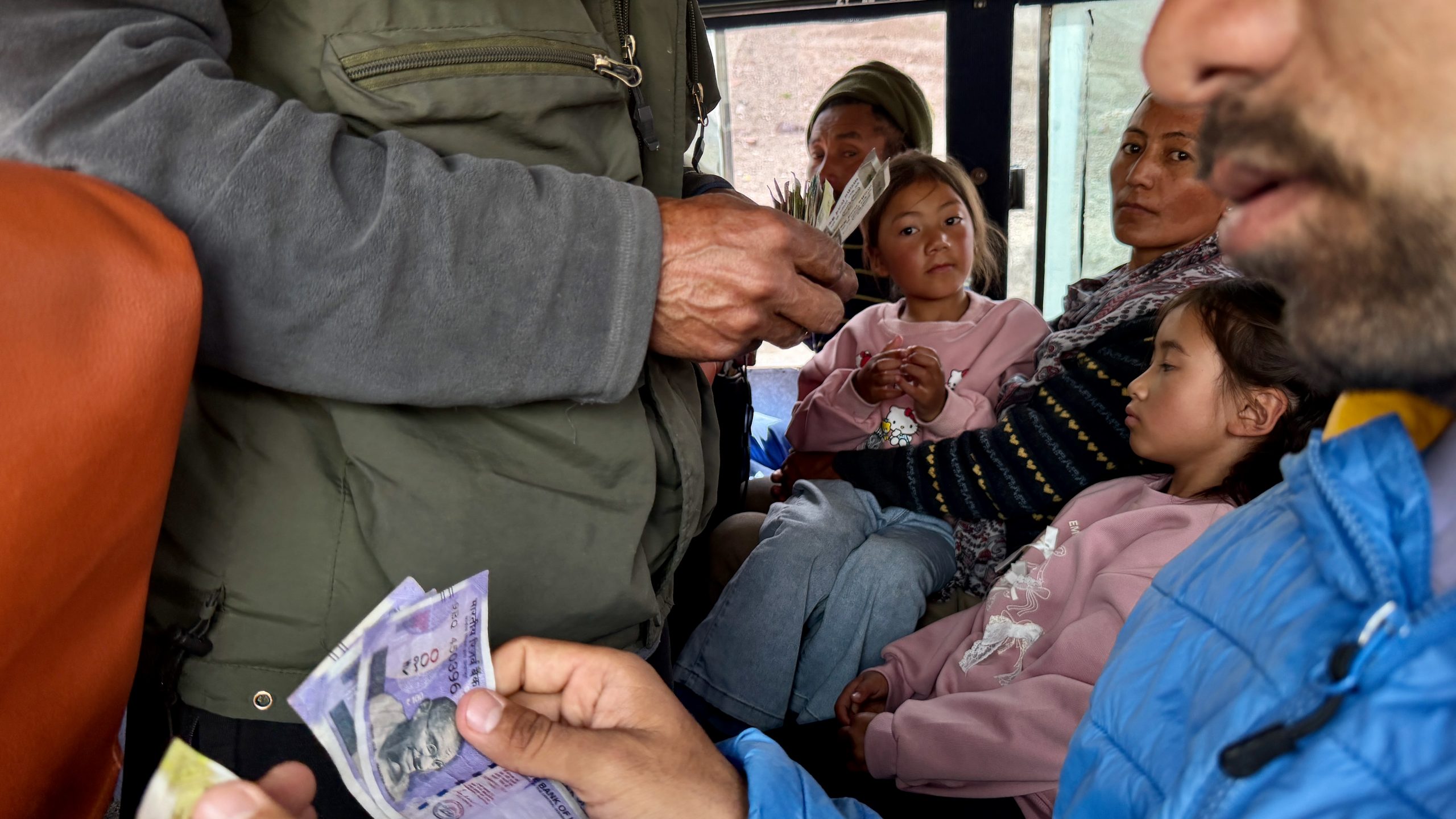
I was in contact with an accommodation provider in Garkone that also runs a museum, and they arranged a guide for me from neighboring Beama, who got onto the bus with me and my lumbago-stricken back. The bus chugged along for seven hours covering the 180 km on what was actually a good road. I had a permit, but when you are sitting on a local bus, the driver has no desire to deal with exceptions at the checkpoint and just drives right through. In fact, the bus driver had to do everything entirely on his own; he didn’t have any of the usual helpers or ticket collectors with him.
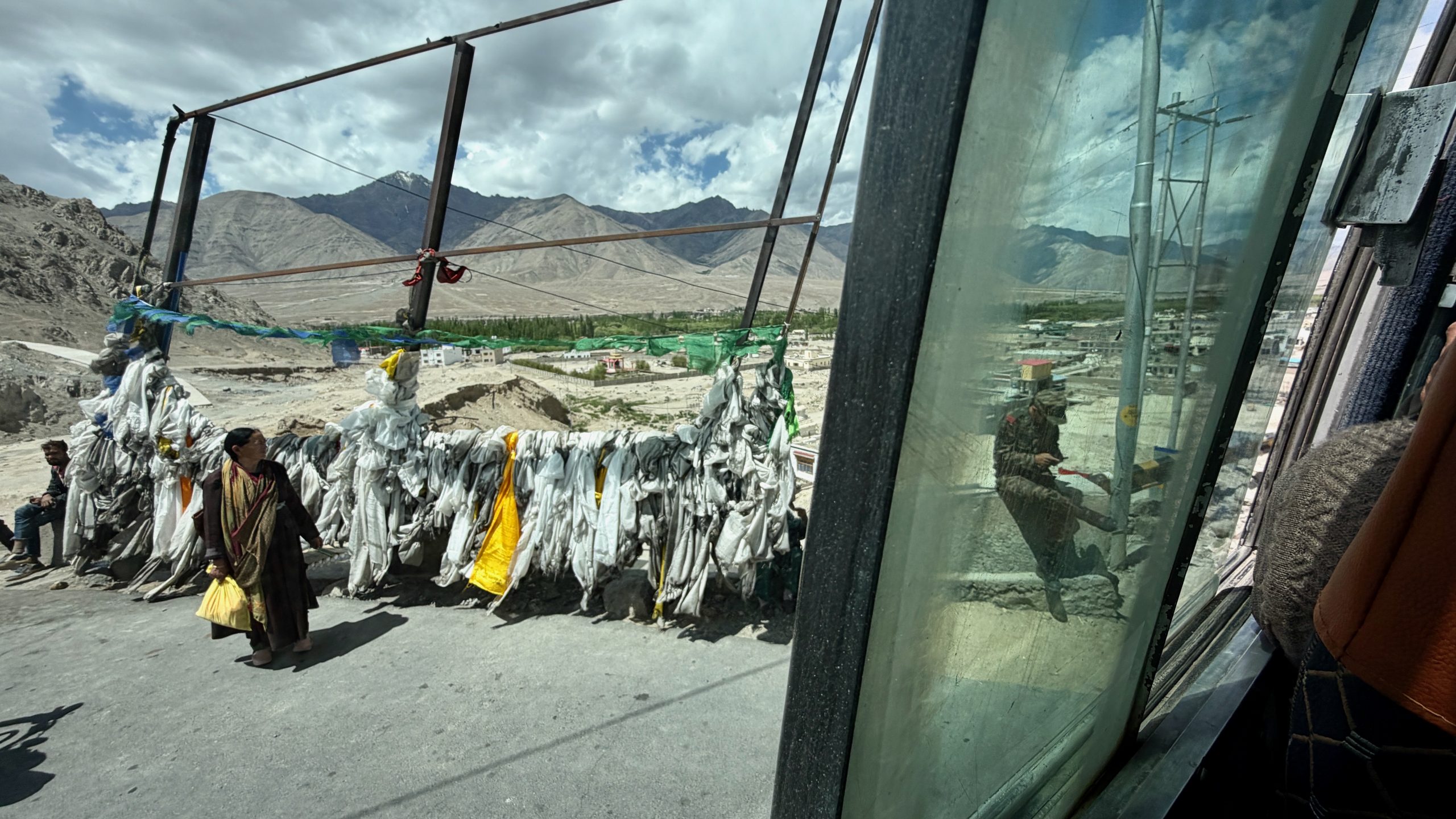
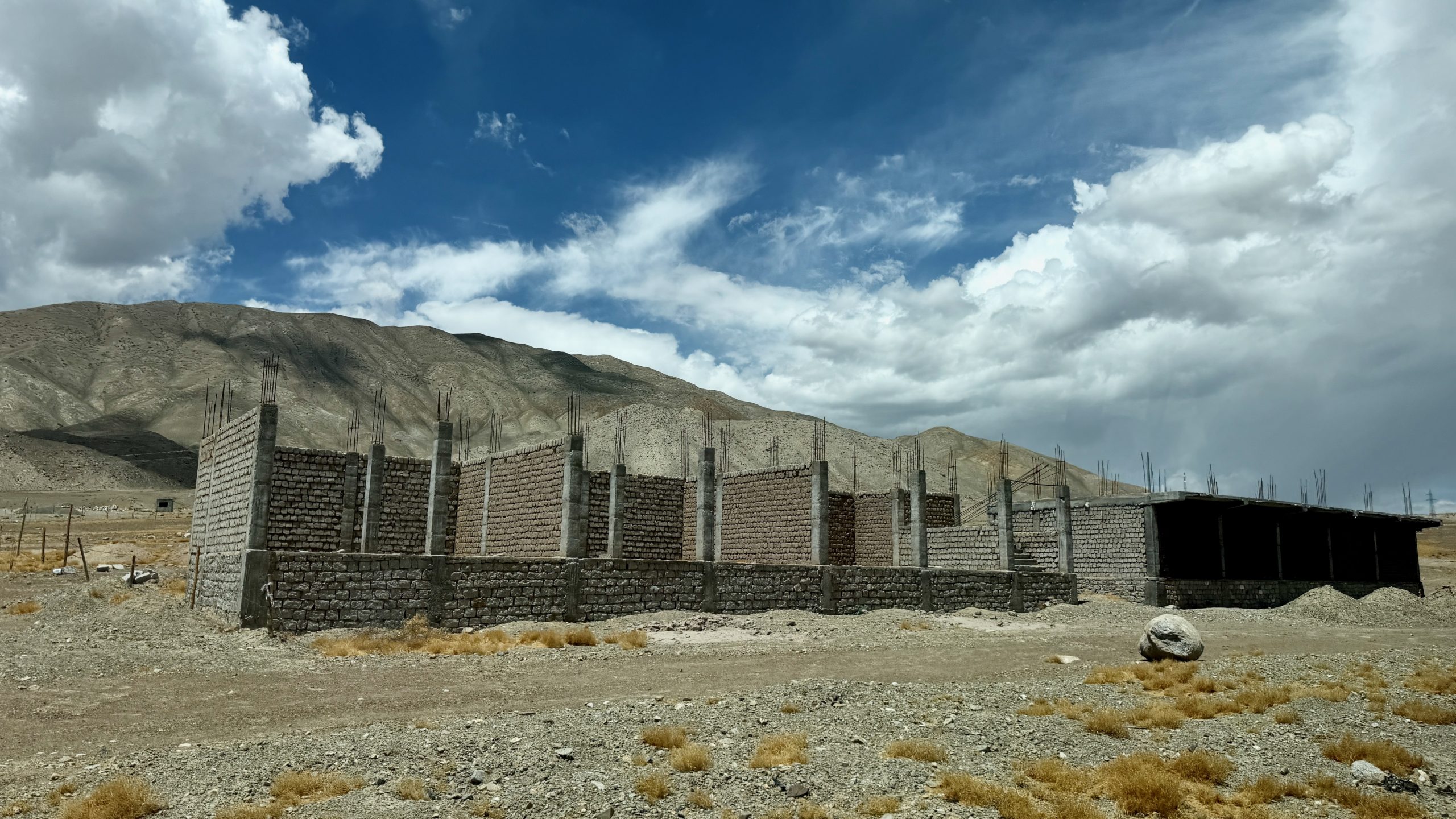
During the drive through Ladakh, I was struck even more by how these previously completely open spaces had now turned into property—fences, house skeletons, buildings, companies. Ladakh had been robbed of its emptiness. In winter, it wasn’t quite as noticeable because there were so few people around and everything was closed. But now in summer, it was different. And I realized how I was becoming increasingly detached. My amazement was more negative than enthusiastic.
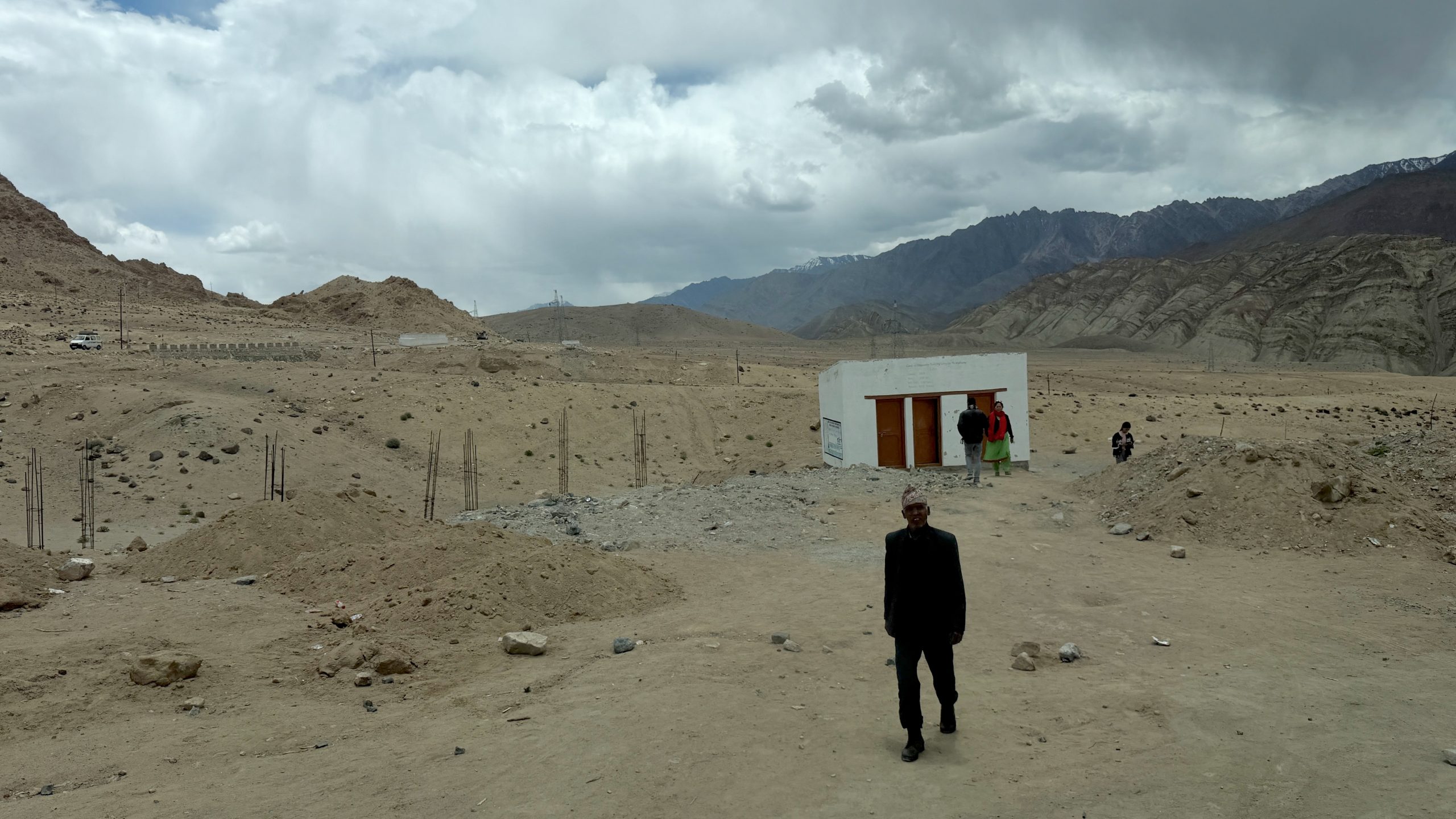
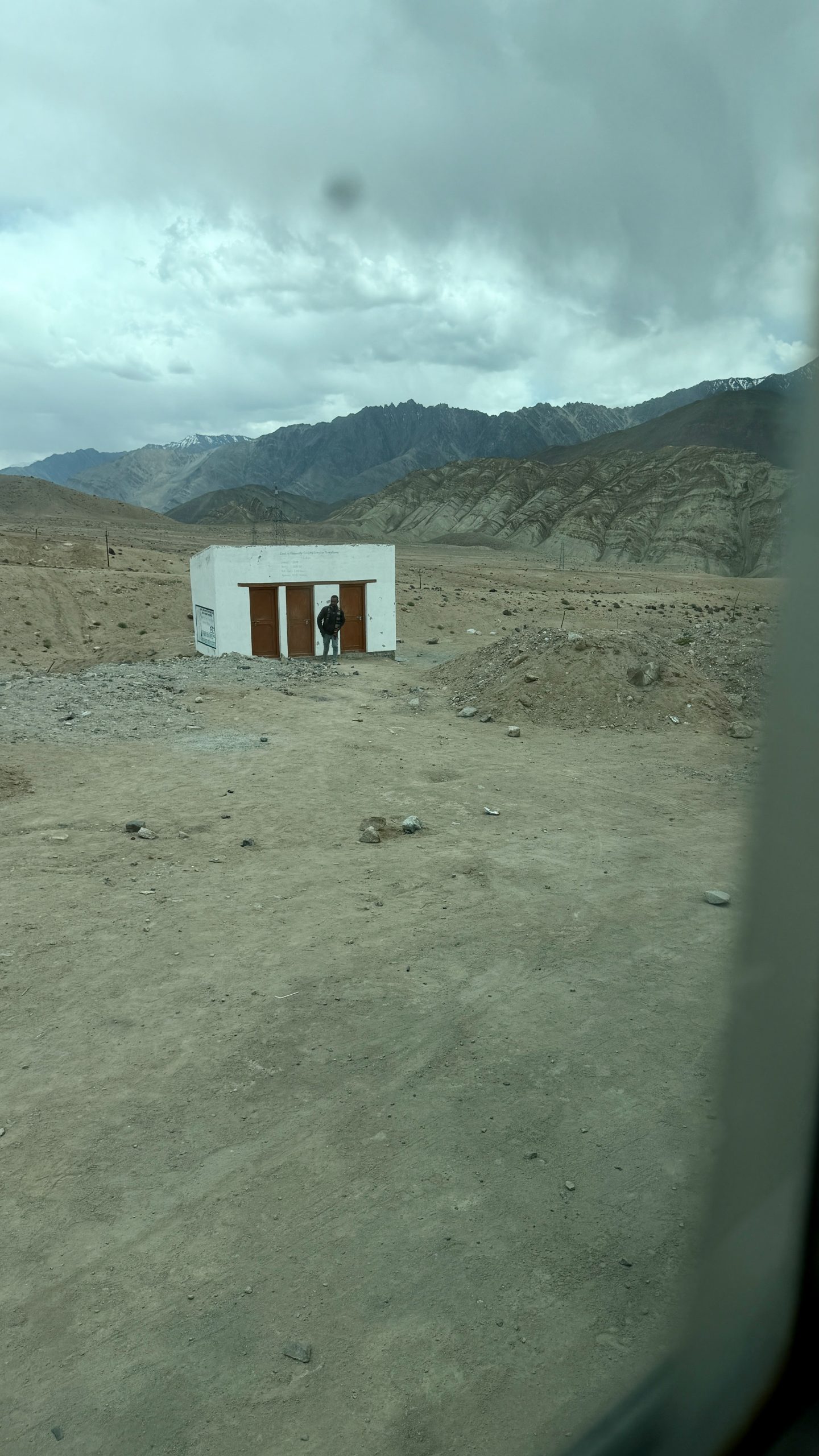
Once we stopped at a loo.
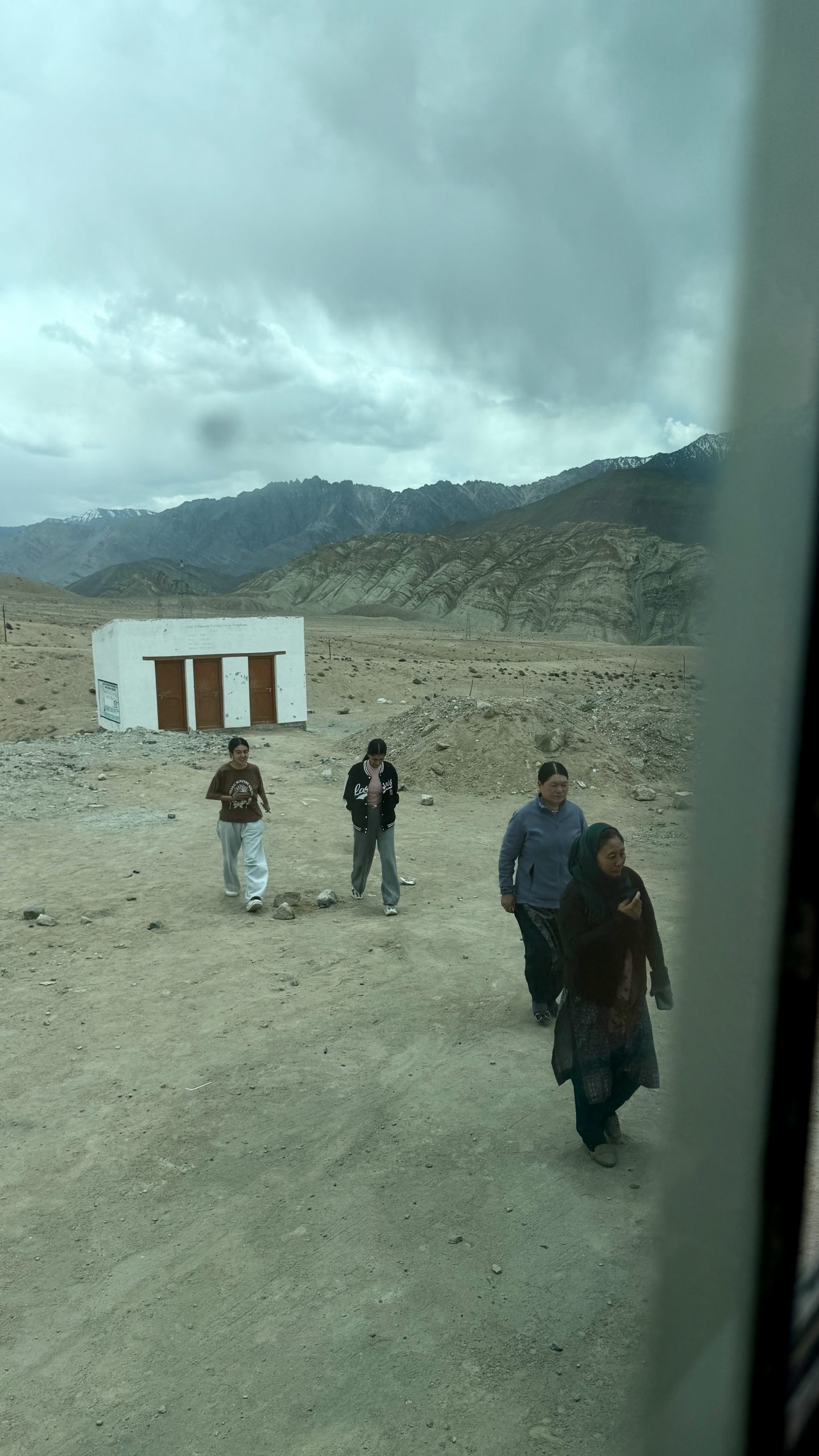
Then the bus stopped and the driver collected the ticketmoney.
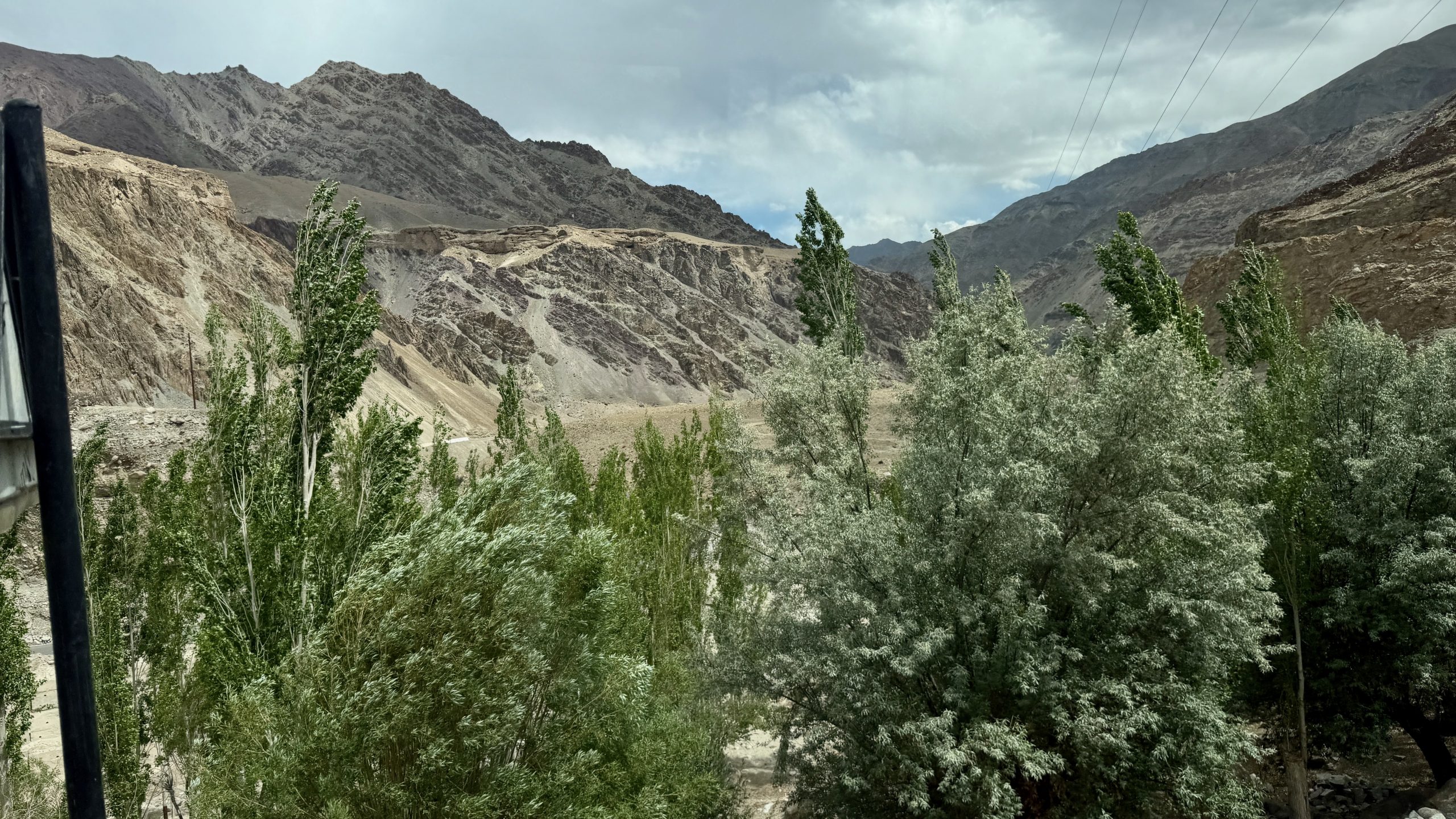
After Khaltse, the road branched off and followed the Indus. The valley became narrower and narrower.
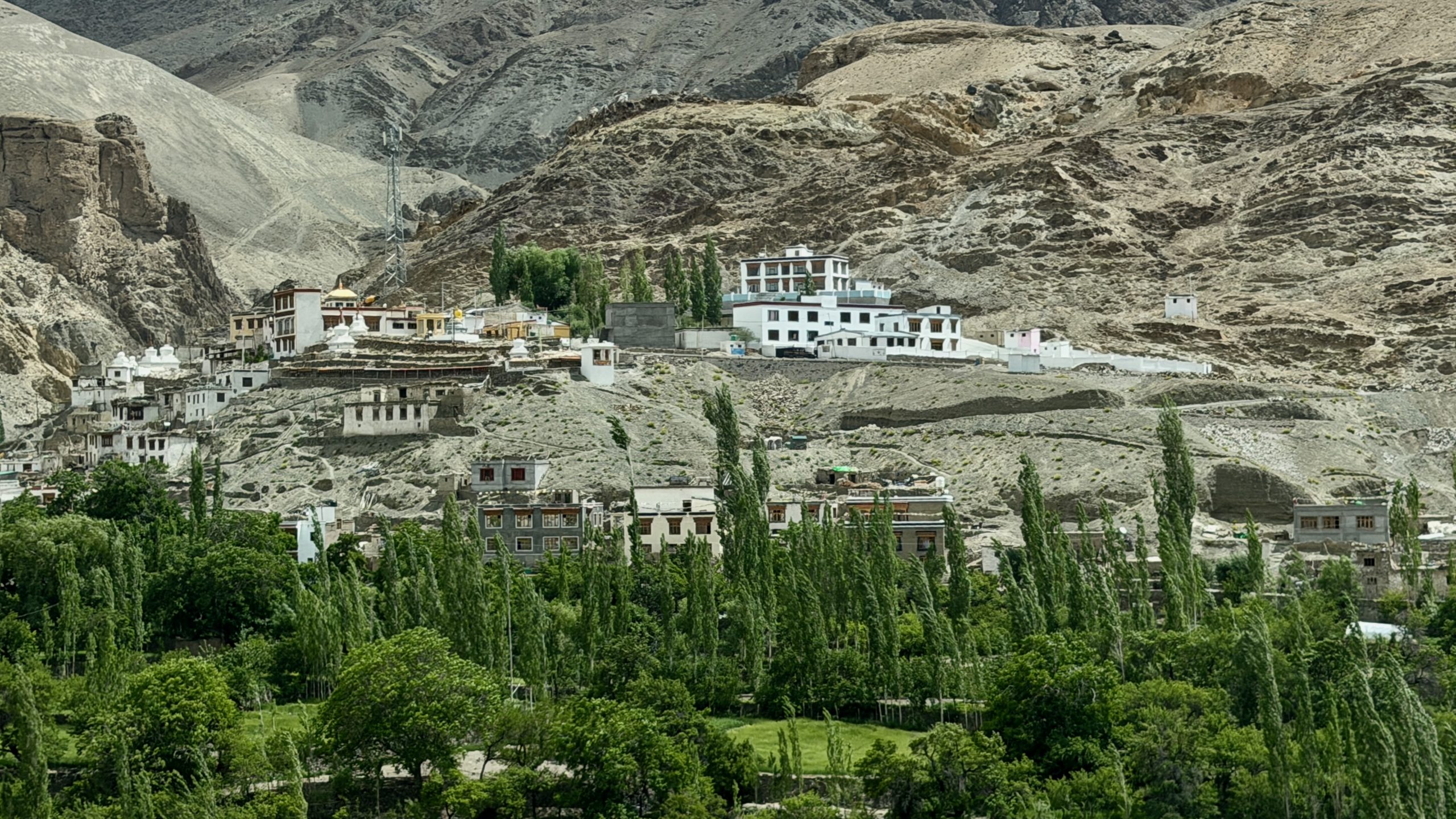
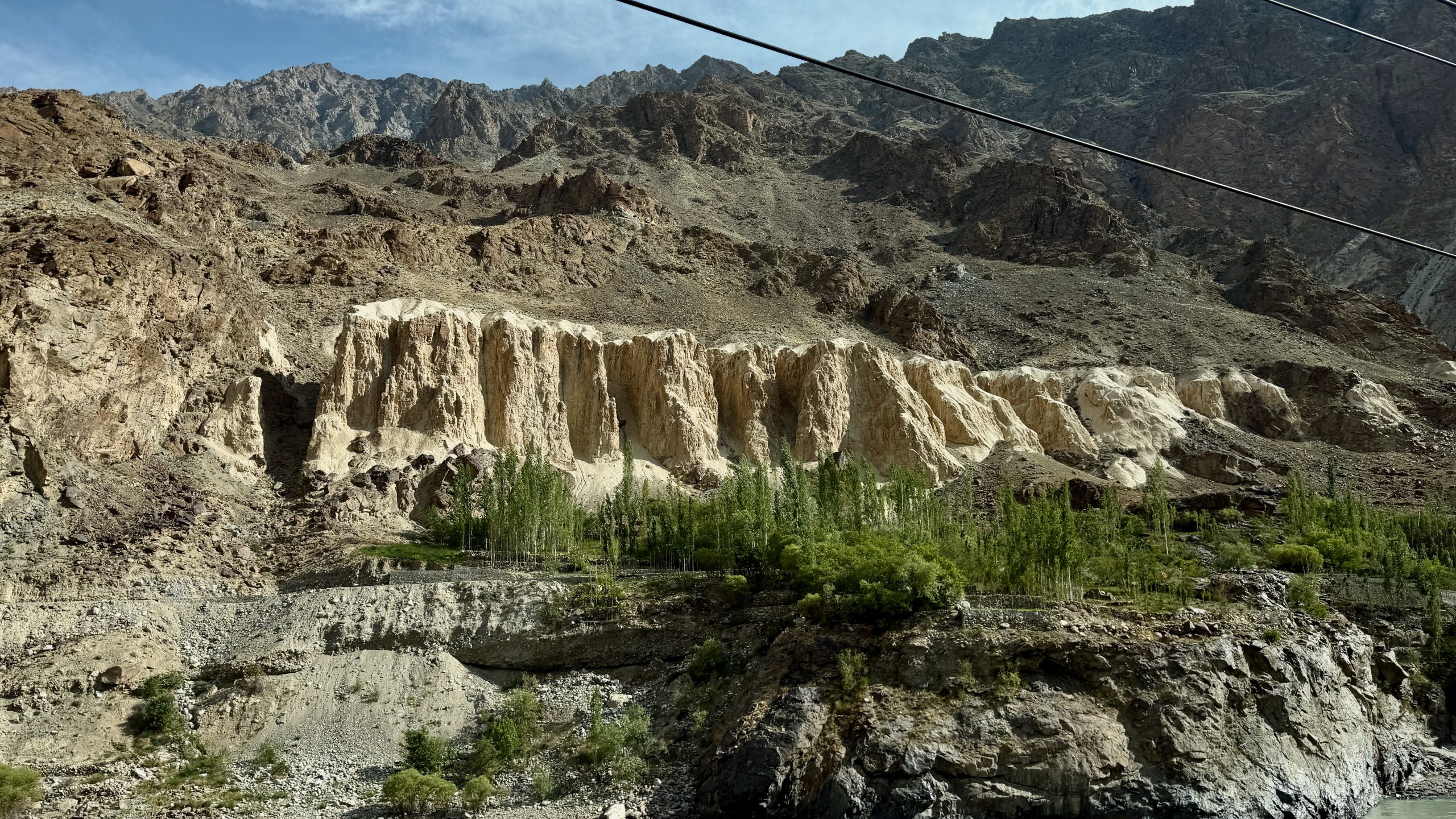
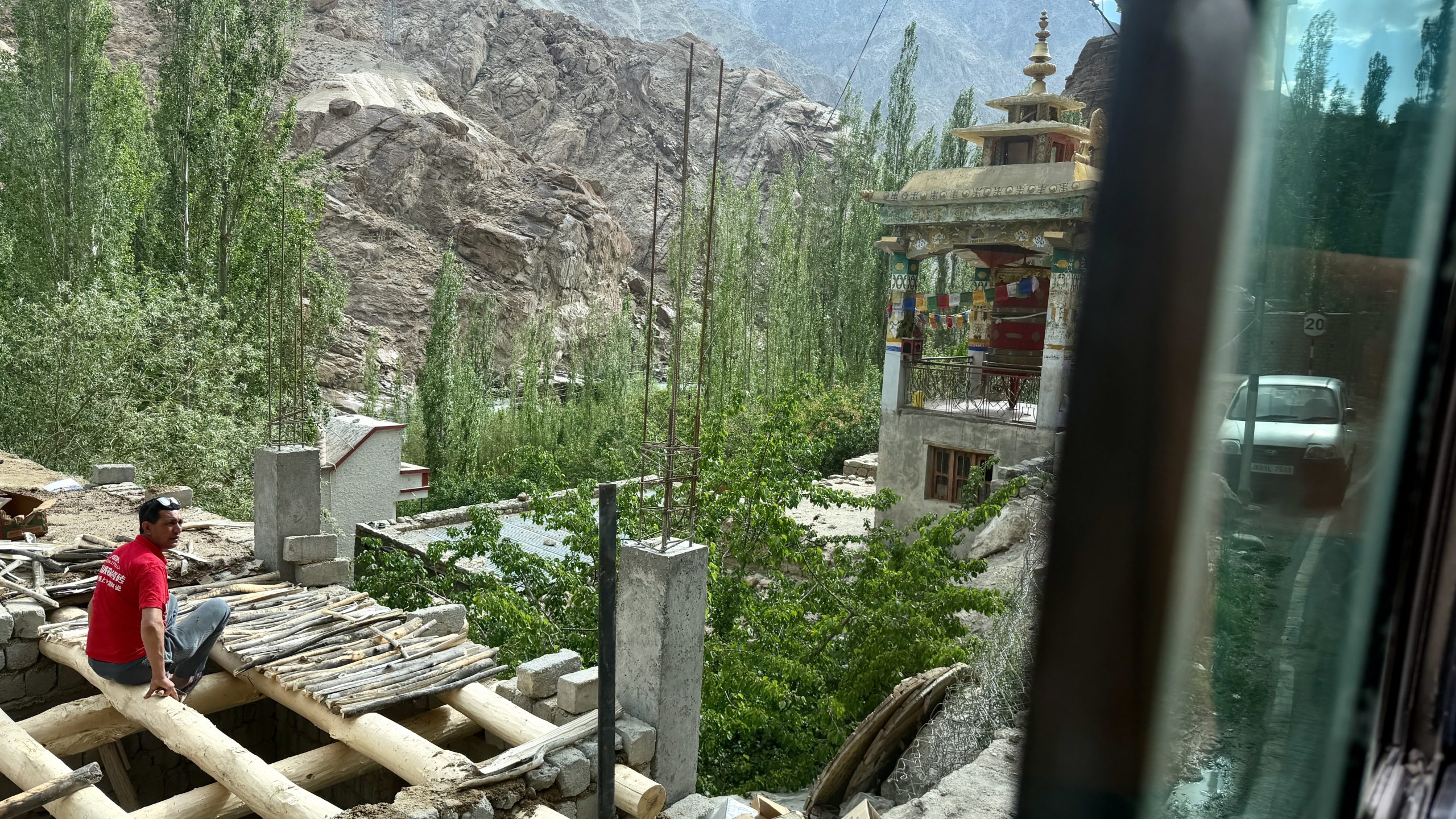
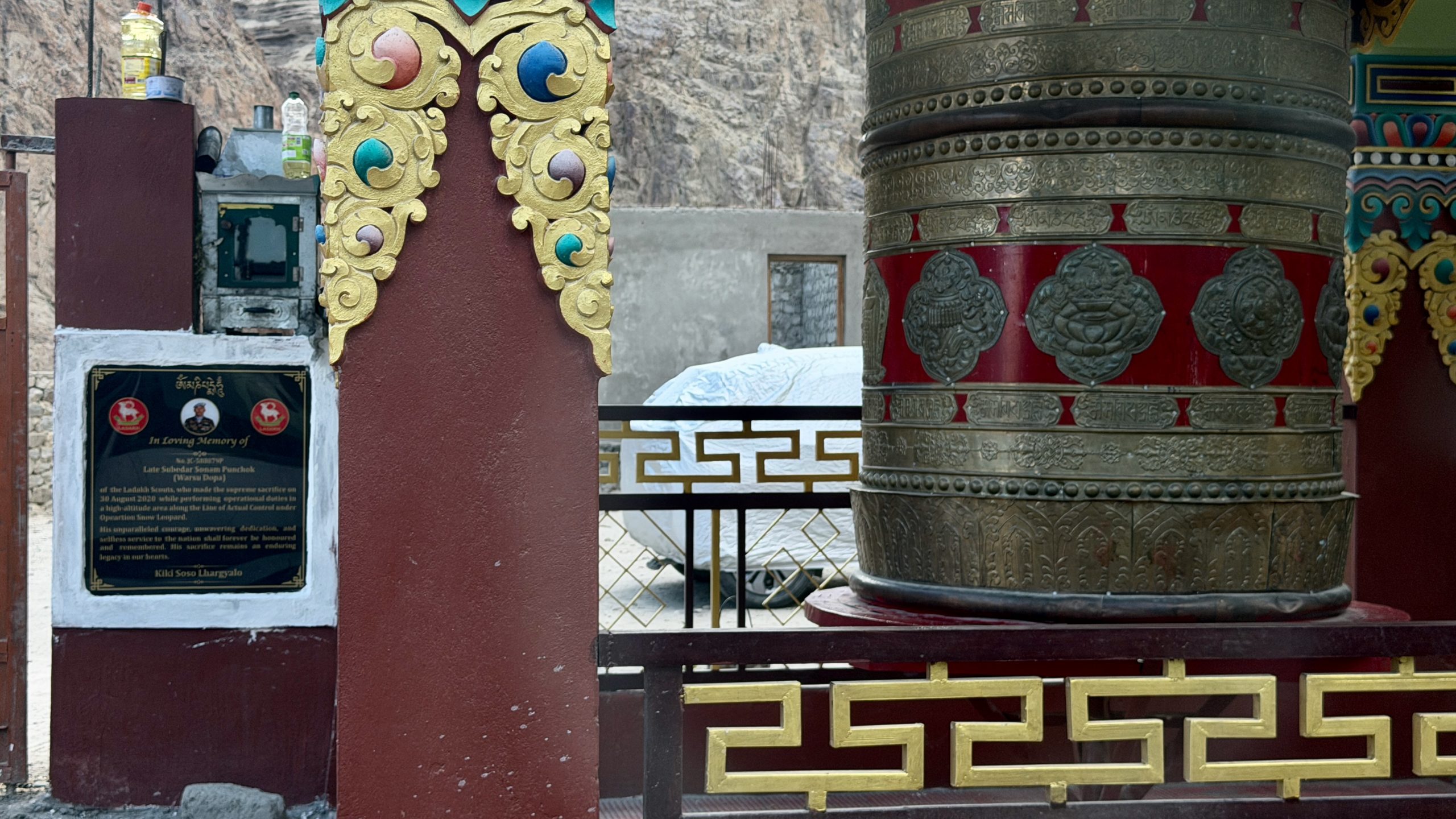
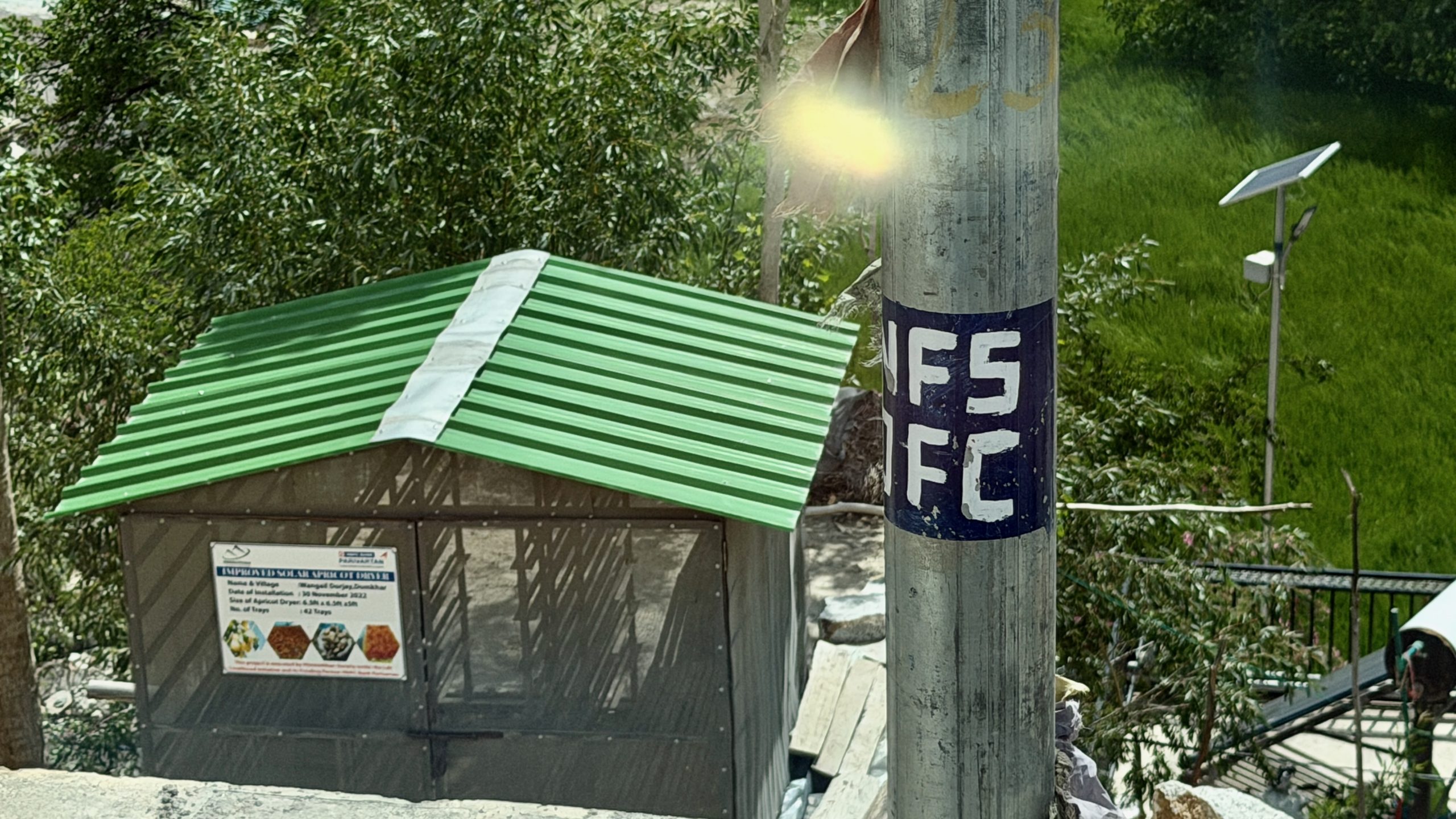
There were little observations to be made:
– Nowadays, when someone passes away, people often dedicate a prayer wheel with an accompanying plaque to them. I have seen this quite frequently by now.
– There are sponsored solar apricot-drying setups. However, nobody uses them because drying them in the sun on the rooftop works better (though who knows how that will be with the increased rainfall due to climate change).
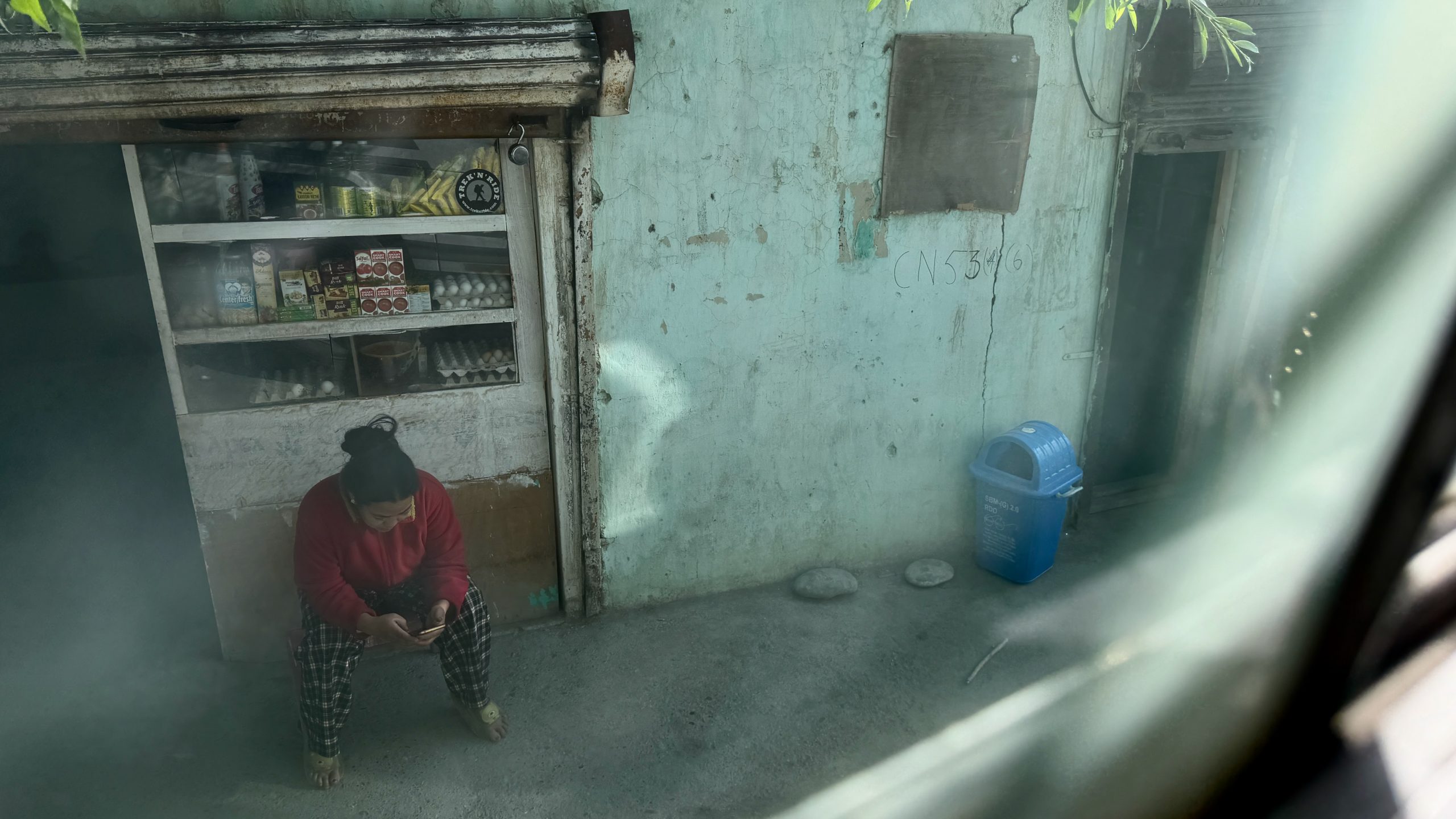
– Quite a few items were being transported back and forth by bus, so we stopped at various points to unload—like here at this kiosk, where the bus driver took the opportunity to grab a cup of tea.
nd then we arrived in Garkone, one of the main tourist hubs of the Brokpa people. And I will tell you all about that, as well as my guide Tani, in the next blog post. That’s enough background information for now, anyway. What does all this context do to you when you actually travel to a place like this?
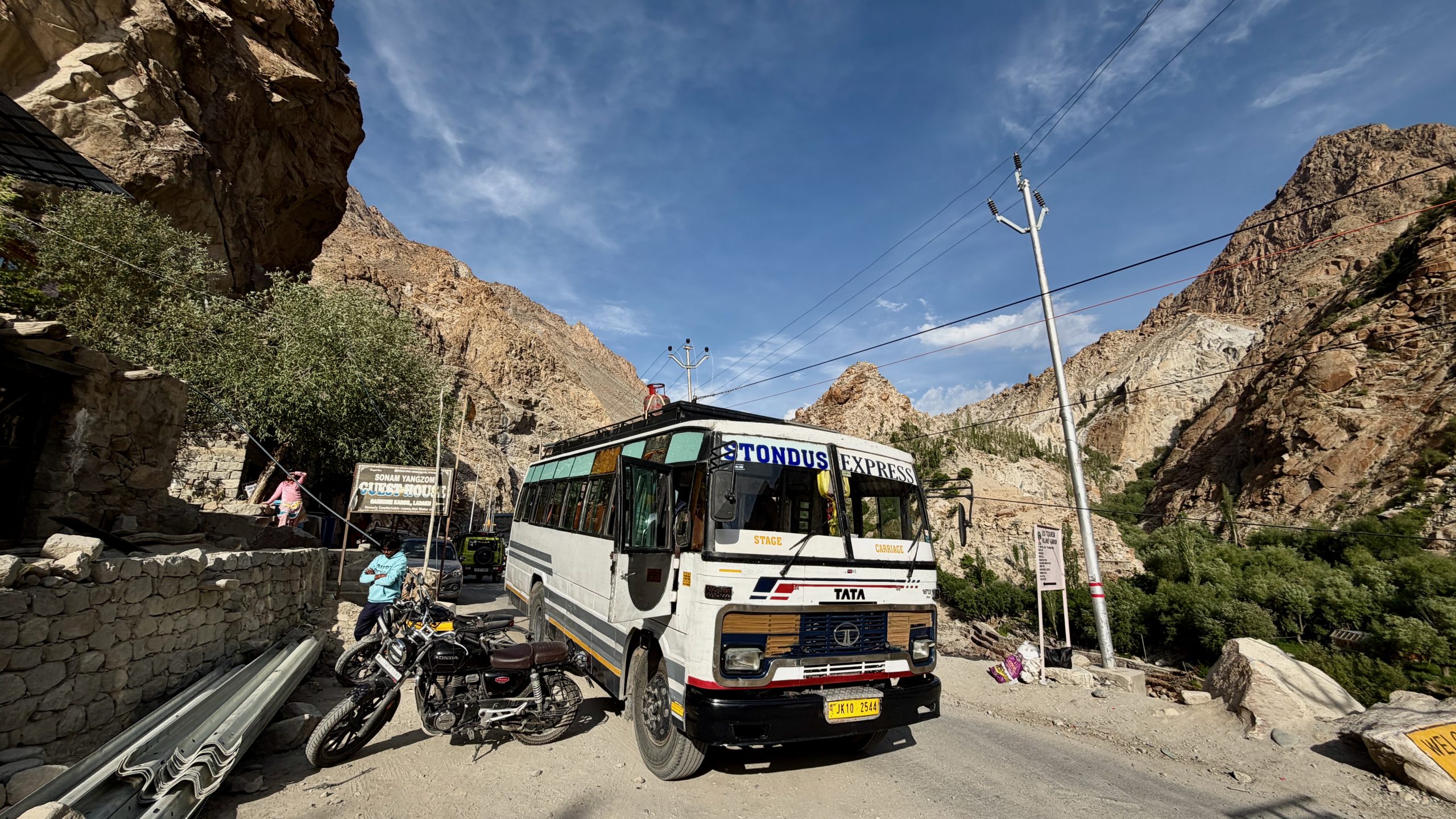
My lower back wasn’t great, but it hadn’t gotten any worse either—so that was already a good thing!